

Having a high arch can often feel like a hidden burden, where every step sends unabsorbed shockwaves up your legs and spine. While flat feet get a lot of attention, those of us with rigid, elevated arches face a unique set of biomechanical challenges that rapidly drain our energy. If you are wondering why high arches need support and how custom orthotics prevent foot fatigue, the answer lies in understanding how this specific foot structure interacts with the ground.
Without the natural ability to flatten and absorb impact, high-arched feet force the outer edges of your soles and your lower leg muscles to work overtime. This constant overcompensation leads to achy, tired feet long before the day is done. By filling the gap between your foot and the floor, we can redistribute that pressure, allowing you to walk, run, and stand with significantly less strain and far more comfort.
Understanding High Arches (Pes Cavus) and Foot Biomechanics
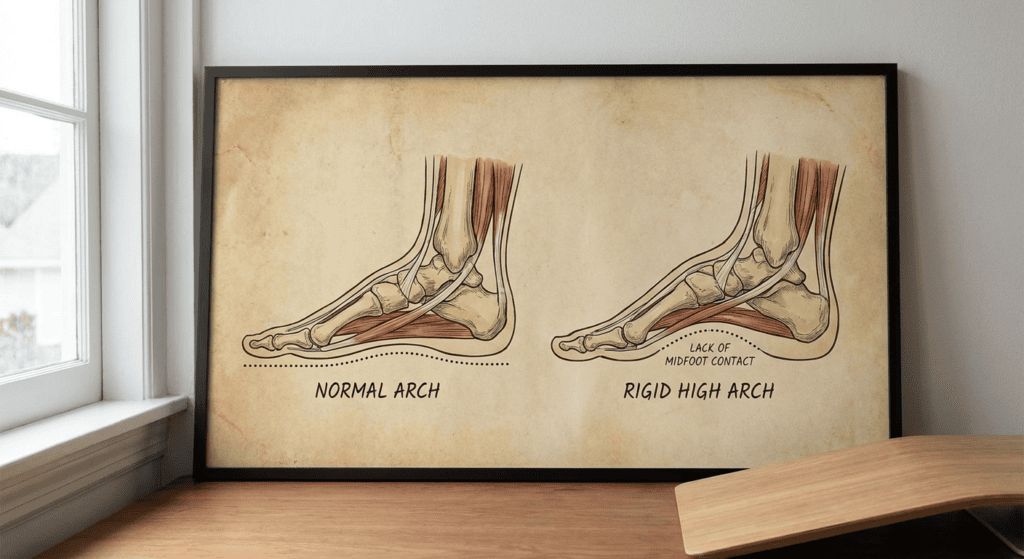
To understand the mechanics of foot fatigue, we first have to look at the anatomy of a high arch, medically known as pes cavus. In a typical foot, the arch acts as a natural shock absorber. When you take a step, the foot flattens slightly, absorbing the impact of your body weight and adapting to uneven surfaces.
However, a high-arched foot is inherently more rigid. Because the arch sits much higher off the ground, it lacks that essential flexibility. Instead of rolling naturally to absorb shock, the foot remains stiff, forcing a much smaller surface area to bear the entire weight of your body. This rigid biomechanical structure is the primary reason why high arches need support: how custom orthotics prevent foot fatigue begins with addressing this lack of natural shock absorption.
The Link Between High Arches, Supination, and Foot Fatigue
When you walk on high arches, your foot naturally tends to roll outward—a movement known as supination or underpronation. Because the arch does not flatten to distribute weight, your body instinctively shifts its load to the outer edge of the foot. This means your heel, the ball of your foot, and your outer toes are taking a relentless pounding with every single step.
This biomechanical imbalance is exhausting for your lower body. Your calf muscles, ankles, and the stabilizing tendons in your legs have to work significantly harder to keep you balanced on an unstable, outward-leaning foundation. As these muscles fire continuously to compensate for the lack of arch flexibility, they tire out rapidly, leading to the deep, aching foot fatigue that so many people with high arches experience by the end of the day.
Common Symptoms and Complications of Unsupported High Arches
When the foot cannot properly absorb shock or distribute weight, the resulting stress manifests in several painful conditions. Recognizing these symptoms is often the first step toward seeking proper biomechanical correction.
Plantar Fasciitis and Heel Pain
The rigid nature of a high arch puts immense tension on the plantar fascia, the thick band of tissue running across the bottom of your foot. This constant stretching and strain frequently lead to inflammation, causing sharp, stabbing heel pain that is typically most severe when you take your first steps in the morning.
Metatarsalgia (Ball of Foot Pain)
Because the middle of a high-arched foot rarely touches the ground, an excessive amount of your body weight is concentrated directly on the metatarsal heads—the ball of your foot. Over time, this intense, localized pressure causes a painful inflammatory condition known as metatarsalgia, often accompanied by the development of thick calluses.
Ankle Instability and Claw Toes
The outward rolling motion of supination makes the ankle highly unstable and incredibly prone to lateral sprains. Furthermore, to compensate for the lack of balance, your toes may begin to grip the ground excessively. This unnatural gripping can lead to the development of painful toe deformities, such as claw toes or hammertoes.
Why High Arches Need Specialized Support
The fundamental problem with a high arch is the empty space between the midfoot and the floor. When that gap is left unsupported, your heel and forefoot are forced to endure the entirety of your body weight. Specialized support is required to literally bring the ground up to meet your arch. By filling this void, we can evenly distribute pressure across the entire surface of the foot, instantly relieving the concentrated stress on your heel and metatarsals.
How Custom Orthotics Prevent Foot Fatigue and Injury
With over fifteen years of clinical practice and a track record of performing over ten thousand spinal and extremity adjustments, we have seen exactly how transformative proper foot alignment can be. Having helped over five hundred athletes return to their sport after an injury, we know that addressing foot mechanics is crucial for full-body recovery. Here is how custom orthotics actively work to keep your feet energized and injury-free.
Targeted Shock Absorption
Because a rigid high arch cannot absorb impact naturally, custom orthotics are engineered with specialized materials that take on this role. They act as a synthetic shock absorber, dampening the force of each step before it can travel up your legs and into your spine.
Enhanced Lateral Stability
To combat the outward rolling of supination, orthotics provide a deep heel cup and precise lateral support. This keeps the foot in a neutral alignment, preventing the ankle from tipping outward and drastically reducing the risk of sprains.
Reduction of Muscle and Tendon Strain
By providing a stable, fully supported foundation, orthotics eliminate the need for your lower leg muscles to constantly overwork just to keep you balanced. When your muscles and tendons are not straining to stabilize an uneven foot, foot fatigue is significantly reduced.
Custom Orthotics vs. Over-the-Counter Insoles for High Arches
It is tempting to grab a generic, mass-produced insole off the shelf, but these products are designed for the average foot. They may offer a bit of soft cushioning, but they completely lack the structural rigidity required to support a pes cavus foot. A high arch will simply crush a flimsy foam insert, rendering it useless.
We prioritize evidence-based treatments and believe in addressing the root cause of your pain. By taking a precise 3D scan of your foot, we ensure that your custom orthotics match your exact biomechanics, providing the exact degree of firm support your high arches demand.
Choosing the Right Footwear to Complement Your Custom Orthotics
Even the best custom orthotics need to be paired with the right footwear to function optimally. If you have high arches, you should look for neutral shoes that offer plenty of inherent cushioning to aid in shock absorption. A firm heel counter is also essential, as it works in tandem with your orthotic to lock the ankle in place and prevent supination.
We always advise our patients to avoid minimalist shoes or completely flat footwear, as these provide zero structural support and will quickly undo the biomechanical benefits of your orthotics. When shopping for shoes, ensure there is enough depth in the toe box to comfortably accommodate both your foot and the custom insert without causing painful friction.
Taking the Next Step: Getting a Professional Biomechanical Assessment
We understand that stepping into a clinic for the first time can feel daunting, especially if you have experienced temporary fixes or rushed appointments elsewhere. That is why our patient care journey is designed to be thorough, transparent, and entirely centered around your comfort. From the moment our friendly front desk receptionist greets you by name, we ensure you are seen on time and never feel rushed. We maintain a pristine clinic environment, meticulously sanitizing our treatment tables and gym equipment between every single visit.
If you are tired of living with aching feet and constant lower leg fatigue, it is time to address the root cause of your discomfort. Schedule your initial consultation today to take the first step toward a pain-free life. With flexible scheduling , we make it easier than ever to get the expert care you deserve.